Independent field guide
Berry season brings bears closer to Lake Louise trails
Last updated:
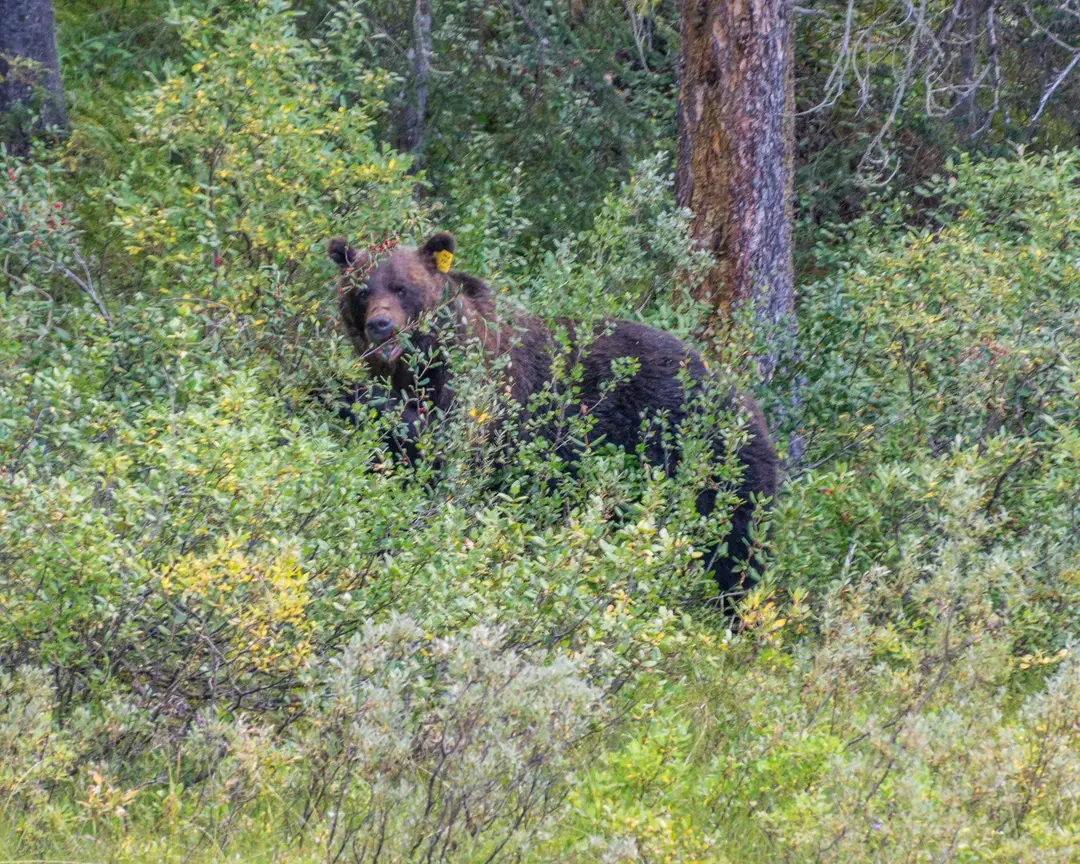
July 22, 2026. Berry season is underway around Lake Louise, and that changes where bears spend their time.
Late July is when fruit starts becoming a major part of a bear’s day. The same shrubs that grow beside trails also grow along roads, railway tracks and open valley edges. Bears follow that food. You can meet one on a familiar, well-travelled route, not only deep in the backcountry.
This does not mean every walk produces a bear sighting. A quiet day with no bear is a normal day. It does mean you should carry bear spray and pay attention to what is growing beside you.
What’s ripening
Buffaloberry, also called soapberry, is the important one. Shepherdia canadensis produces red or orange berries that ripen in late summer. It grows in open forest, along forest edges, on disturbed or burned ground, and beside road and rail corridors. That habitat puts feeding bears close to people and traffic.
The fruit contains saponins and tastes soapy to people. It is edible, but it is not usually the berry you stop to snack on. For bears, it is a key high-volume food.
You will see other fruit too. Blueberries, huckleberries and grouseberries are Vaccinium species found in open forest and subalpine meadows. Grouseberry carpets much of the understory in Larch Valley and turns red or burgundy in fall.
Saskatoon, or serviceberry, is Amelanchier alnifolia. Its sweet fruit grows around montane edges. Bearberry, Arctostaphylos uva-ursi, is also called kinnikinnick. Its berries are red and mealy. Despite the name, it is not the tasty one for people.
Do not pick the berries. Collecting berries, plants, or any natural object is not allowed in the national park; the fruit is left for the wildlife that depends on it, and in late summer that means bears. The rule aside, a heavy patch of ripe fruit is a bear’s dining room. Do not linger in dense fruiting shrubs, and give any feeding bear a wide berth.
Why the bears follow the berries
Buffaloberry ripening is the biggest seasonal pull bringing grizzlies into valley bottoms and onto lower trails in late summer. A feeding bear may spend much of the day moving from shrub to shrub with its head down. Bear researchers and Parks Canada have estimated that a grizzly can eat tens of thousands of buffaloberries, by some counts well over 100,000, in a single day during peak season.
That amount of feeding takes space. It also explains why encounters increase on busy routes. Productive shrubs grow beside paths and through narrow corridors where sightlines are short. Roads and the railway have the disturbed ground buffaloberry favours, so bears can end up close to vehicles and trains while doing nothing more unusual than eating.
Both grizzly bears and black bears use this landscape. Grizzlies are a Species of Special Concern, and Banff’s population is measured in the dozens. Giving a foraging bear room is not only about avoiding an encounter. It helps a small population keep access to an important food source without becoming displaced or getting into conflict.
Parks Canada uses seasonal closures and minimum-group-size, or tight-group, access rules on some trails when bears are foraging. Those measures can change. Check the current bulletins rather than assuming last year’s rule, or yesterday’s conditions, still apply.
Carry bear spray, and use berry sense
Every trail here is bear country, from valley bottom to alpine. Each person should carry one canister of bear spray. Keep it on your belt or chest, not inside your pack. You need to reach it within a couple of seconds.
Most canisters have an effective range of roughly 8 to 10 metres. Use a short burst as an approaching bear closes within range. Check the expiry date before leaving. Canisters lose pressure, and an expired one should be replaced. The bear-spray section of the safety guide has the full checklist, including how to carry it on a shuttle and how to avoid spraying yourself or others.
Make noise as you travel. Talk, clap or call out near streams, in dense brush and before blind corners. This matters more in berry season, when a bear may have its head down and be focused on feeding. Slow down where ripe shrubs block your view. If you find a bear on a patch, back away and leave the food to it.
You cannot take bear spray on a flight. Buy or rent it after you arrive. Wilson Mountain Sports carries it in Lake Louise, and retailers in Banff and Canmore do too.
Short version: ripe berries bring bears onto the same low trails and corridors people use, so carry spray, make noise and give every feeding bear space.
Where to verify
Check the current Banff National Park bulletins for closures, warnings and any group-access rules before you leave. Parks Canada’s wildlife and bear safety guidance covers current advice for encounters and travel in bear country.